Termite treatment resolves structural vulnerabilities caused primarily by the Eastern subterranean termite, the single native termite species established throughout Franklin County. In neighborhoods like German Village…
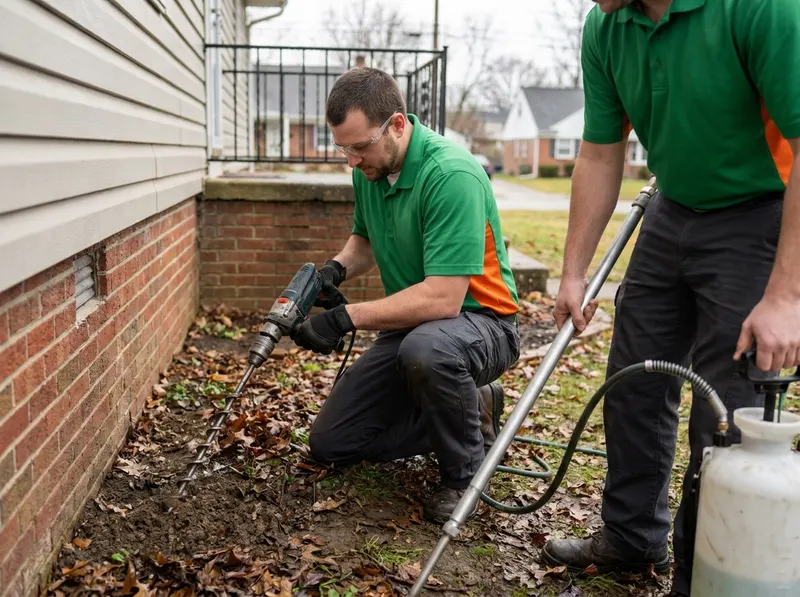
Termite treatment resolves structural vulnerabilities caused primarily by the Eastern subterranean termite, the single native termite species established throughout Franklin County. In neighborhoods like German Village and Victorian Village, older brick foundations, stone footers, and direct soil-to-wood porch attachments allow worker termites to construct sheltered mud exploration tubes unnoticed behind baseboards. Modern split-levels and slab construction common in Upper Arlington, Worthington, and Bexley face subterranean entry through expansion joints, plumbing penetrations, and perimeter garage aprons. Structural safety requires identifying whether insects have penetrated primary sills or merely landscape features before applying termiticide.
Selecting the proper treatment protocol depends entirely on foundation architecture. Liquid non-repellent termiticide barriers involve digging a shallow trench (typically 6 inches wide by 6 inches deep) directly adjacent to foundation walls, rodding the solution into the soil bed, and patch-drilling concrete patios at 10-to-12-inch intervals. This continuous liquid envelope halts termites passing between subterranean nesting sites and indoor framing timbers. The alternative approach, cellulose bait station arrays installed every 10 to 15 linear feet around the yard perimeter, suits river-adjacent properties near the Scioto Mile Promenade or homes in Clintonville with mature tree canopy roots that inhibit continuous soil trenching. Bait systems rely on worker termites transporting active insect growth regulators back to the central subterranean queen over an 8-to-16-week window, whereas continuous liquid soil treatments establish immediate contact barriers within 24 to 72 hours.
A single isolated localized spot application can temporarily eliminate active swarmers inside a basement room, but it leaves unaddressed foundation perimeters exposed to ongoing foraging. For long-term structural security, comprehensive exterior perimeter applications provide verified boundary integrity without locking homeowners into unnecessary ongoing multi-year subscription plans. Treatments in historic Franklinton, Grandview Heights, and Hilltop row homes are tailored to property boundaries, focusing strictly on resolving active infesting colonies, sealing structural foundation gaps, and restoring household peace of mind.
Every job gets a firm, written price after a free on-site visit.
Tell us about your termite treatment job in Columbus and we'll send a clear, written quote, usually the same day.
 Kelmar Pest Services