Rodent migrations into Franklin County homes surge during autumn when evening temperatures drop below 45 degrees Fahrenheit, driving Norway rats and house mice toward heat plumes radiating from stone basements, crawl…
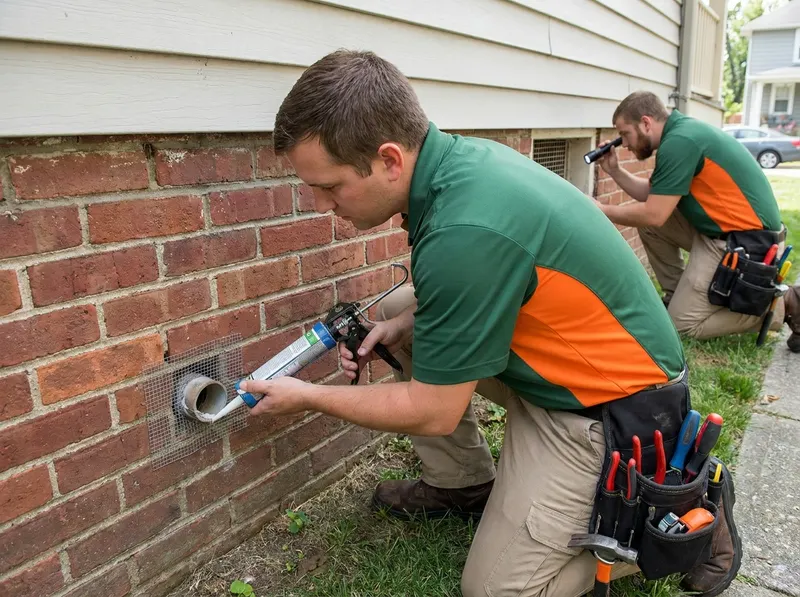
Rodent migrations into Franklin County homes surge during autumn when evening temperatures drop below 45 degrees Fahrenheit, driving Norway rats and house mice toward heat plumes radiating from stone basements, crawl space vents, and roofline soffits. Historic architecture throughout German Village, Victorian Village, and Clintonville features permeable rubble foundations, unsealed plumbing chases, and limestone masonry gaps that rodents exploit. A mouse requires an opening of only one-quarter inch, roughly the diameter of an ordinary pen, while a rat forces access through a half-inch void. Conventional extermination methods rely on broadcast rodenticides, which leave decaying carcasses inside wall cavities and present secondary poisoning hazards to indoor pets and neighborhood wildlife. Targeted rodent control and forensic exclusion shifts the methodology from continuous chemical dependency to permanent physical defense. Technicians examine the structure mechanically, mapping active utility penetrations, deteriorated garage door astragals, and foundation weep holes.
Forensic exclusion resolves infestations by sealing these structural pathways using gnaw-proof materials rather than temporary spray foams. In neighborhoods with older housing stock like Olde Towne East, Franklinton, and the University District, settling structures often create separations between sill plates and masonry. Sealing these gaps requires 19-gauge galvanized hardware cloth, copper mesh, and elastomeric sealants that rodents cannot penetrate. Concurrently, interior populations are eradicated using mechanical snap traps positioned precisely along pheromone rub lines in attics and basements. This protocol prevents rodent decomposition inside finished sheetrock, eliminating foul odors and flea infestations. If a home exhibits an active basement breach without roofline damage, targeted lower-level exclusion resolves the issue; if tree canopies in mature areas like Upper Arlington or Bexley allow roof rats access to attic louvers, upper-envelope remediation is required. The trade-off centers on upfront mechanical labor versus indefinite chemical treatments. Forensic exclusion requires higher initial architectural labor to seal the building envelope, but it eliminates ongoing monthly maintenance contracts and prevents future re-infestation entirely.
Technicians follow a standardized four-step remediation framework on every property. Step 1 is the thermal and visual diagnostic, pinpointing gnaw marks, grease rub tracks, and droppings across interior crawl spaces and attic insulation. Step 2 is mechanical interior capture, placing secured trapping stations away from living areas, domestic pets, and children. Step 3 is structural barrier installation, mechanically fastening heavy-gauge mesh over foundation vents, mortar voids, crawl space doors, and AC refrigerant pipe chases. Step 4 is post-capture validation and sanitization, where technicians remove caught specimens, vacuum pheromone-laden droppings using HEPA-filtered extraction, and apply non-toxic bio-enzymatic sprays to eliminate residual scent trails that attract neighboring rodents from nearby river corridors such as the Scioto River and Olentangy River.
Every job gets a firm, written price after a free on-site visit.
Tell us about your targeted rodent control and forensic exclusion job in Columbus and we'll send a clear, written quote, usually the same day.
 Kelmar Pest Services