Kelmar Pest ServicesKelmar Pest Services

Subterranean Termite Soil Treatment and Monitoring Columbus

Eastern subterranean termites (Reticulitermes flavipes) represent the predominant structural threat across Franklin County, where heavy clay soils maintain moisture along foundation footings. A perimeter liquid trench…
Get My Free Estimate →(380) 267-1530
Subterranean Termite Soil Treatment and Monitoring in Columbus, OH
Quick answer
  • What is included: Perimeter soil trenching, non-repellent liquid termiticide injection, subterranean bait station placement, and an objective annual damage audit.
  • Service timeframe: Initial installation requires 4 to 8 hours for an average Franklin County home footprint, with ongoing monitoring intervals scheduled quarterly.
  • Pricing baseline: Professional treatments start at a verified minimum fee of $150, with complete perimeter barrier installations ranging between $1,200 and $2,800 depending on linear footage.
  • Target pest: Formosan and eastern subterranean termites (Reticulitermes species) nesting in local soil and traveling through foundation mud tubes.
  • Scheduling and access: Technicians confirm property access routes around foundation perimeters and finalize structural measurements via phone at (380) 267-1530.

Eastern subterranean termites (Reticulitermes flavipes) represent the predominant structural threat across Franklin County, where heavy clay soils maintain moisture along foundation footings. A perimeter liquid trench treatment establishes a treated zone measuring 6 inches wide by 6 inches deep around exterior stem walls, porous rubble stone, or poured concrete foundations. Properties with finished basements or slab foundations, common in Upper Arlington, Bexley, and Grandview Heights, frequently require sub-slab vertical drilling spaced at 12-inch increments through concrete walkways and garage aprons to deliver non-repellent liquid barriers directly to hidden expansion joints. Older brick and stone foundations in German Village, Victorian Village, and Olde Towne East present structural voids where subterranean colonies navigate vertical masonry lines without detection, making external soil saturation essential to prevent sill plate degradation.

Non-repellent liquid termiticides do not turn foraging termites away; instead, worker termites pass through the microscopic barrier, pick up the slow-acting active ingredient, and transfer it back to the queen and royal chamber through mutual grooming and food sharing (trophallaxis). Complementary cellulose bait monitoring stations installed every 10 to 15 feet around the drip line provide an early-warning diagnostic layer. If soil conditions shift due to seasonal rain runoff near the Scioto Mile Promenade or along the Olentangy River basin in Clintonville and the University District, bait matrices intercept subterranean colonies scouting beyond the perimeter liquid zone. The technical trade-off between approaches centers on speed versus continuous scouting: liquid barriers immediately isolate the structural wood from ground colonies, whereas baiting systems track colony pressure over multi-year cycles without disturbing finished landscaping or patios.

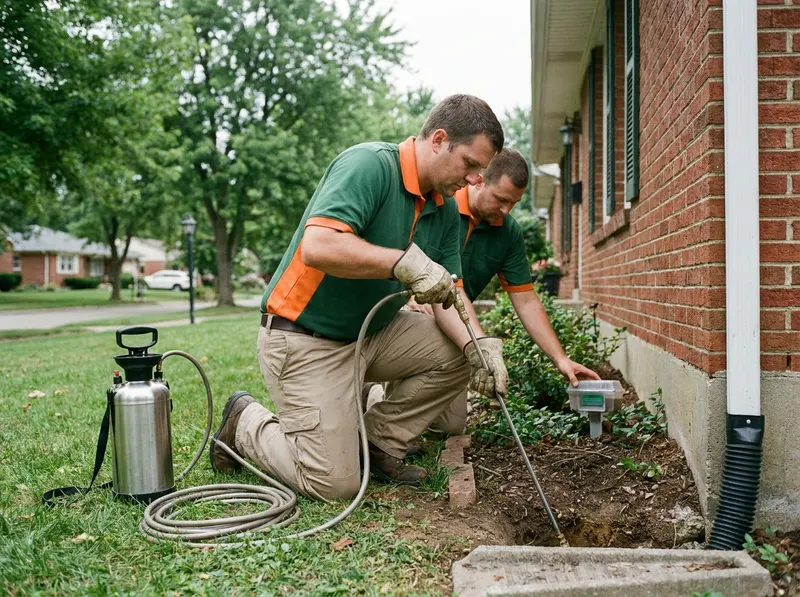
Treatment execution follows four distinct phases: 1. A physical visual inspection maps mud shelter tubes, sheetrock exit pinholes, and soil-to-wood contact points across crawlspaces and sill plates. 2. Exterior soil is excavated into continuous 6-by-6-inch trenches along the exterior stem wall, mixed with termiticide at label dilution rates, and backfilled. 3. Concrete masonry surfaces, stoops, and adjoining patio slabs undergo precision drilling to saturate underlying gravel fill. 4. Tamper-resistant in-ground monitoring stations are seated flush with turf grades for routine inspection. The quoted pricing remains transparent; spot repairs or preliminary diagnostic work observe the strict $150 minimum charge, while full perimeter protection is determined strictly by linear foundation footage, foundation type, and soil composition verified on-site.

Subterranean Termite Soil Treatment and Monitoring cost in Columbus

Diagnostic Inspection and Minimum Callout$150
Localized Spot Soil Injection (Under 20 Linear Feet)$350 - $650
Full Liquid Soil Barrier (150-250 Linear Feet)$1,200 - $2,800
In-Ground Bait Monitoring Station Array (Annual Plan)$400 - $850
Combination Liquid Barrier and Baiting System$1,600 - $3,400

Every job gets a firm, written price after a free on-site visit.

Common questions

How much does termite soil treatment cost on average in Columbus?
Termite soil treatments carry an entry-level minimum charge of $150, with full-perimeter liquid trenching and injection averaging between $1,200 and $2,800 across typical Columbus residential footprints based on measured linear footage and foundation depth.
Are liquid soil treatments safe around children and household pets in Columbus?
Liquid termiticides are injected below grade and covered with compacted backfill soil, which prevents direct exposure to pets, wildlife, and children once the perimeter trench is restored.
How does Franklin County clay soil affect liquid termite treatments in Columbus?
Dense central Ohio clay binds non-repellent liquid termiticides tightly, reducing chemical leaching; however, high compaction requires precision rodding tools to ensure the treatment penetrates to the bottom of the footing without running off.
How often should termite monitoring stations be inspected in Columbus?
In-ground bait stations are checked on a scheduled quarterly cadence between April and October when ground temperatures exceed 50 degrees Fahrenheit and subterranean worker activity peaks.
What is the difference between a termite soil treatment and drywood termite fumigation in Columbus?
Columbus structures face subterranean termites that live in outdoor soil and build mud tubes to reach wood framing, requiring liquid soil barriers and ground baiting rather than the whole-structure fumigation tents used for tropical drywood species.
Helpful resources

Trusted references & local links

USA.gov, government & consumer helpBetter Business BureauFTC Consumer AdviceU.S. Small Business AdministrationReady.govU.S. EPAENERGY STARU.S. Dept. of EnergyConsumer.govU.S. Census BureauGoogle Maps, Columbus, OH

Get started today

Tell us about your subterranean termite soil treatment and monitoring job in Columbus and we'll send a clear, written quote, usually the same day.

Get your free pest control services quote, Columbus

We only use your ZIP to check availability, no spam.